
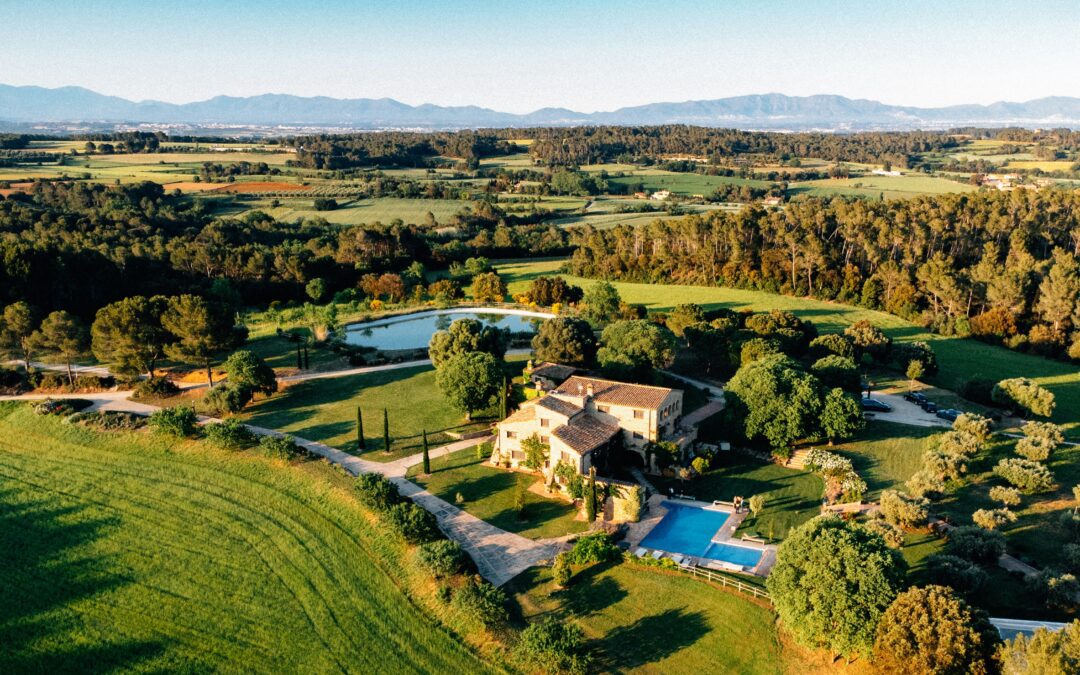
Short answer: renovating a villa or farmhouse in Tuscany, or anywhere in Italy, typically costs between €1,000 and €5,000 per square metre in building works. Where you land depends on three things: the condition of the building, how much work it needs to be habitable, and the finish you want. Americans often call this a remodel; in the UK it’s a renovation or restoration. The numbers are the same.
In 2026, a full restoration of a historic Italian villa typically costs between €2,000 and €3,500 per square metre in construction works. High-level conservation work can go well beyond €3,500 per square metre, while a light decorative refresh can come in around €1,000 or less.
But that is only part of the answer. Once you add professional fees, tax and contingency, the builder’s quote is often only about 70% of what you will actually spend.
I’ve learned this the hard way as well as the professional way. We design and project-manage villa restorations across Italy, and I’ve also made my own expensive mistakes buying here. This guide gives you the numbers most articles skip: what sits on top of the works cost, a real 700 square metre Tuscan case study, where to spend and where to save, and how to get a budget you can actually trust.
Why price per square metre is the wrong question
Everyone searches for a price per square metre, and I’ll give you ours below. But honestly, a square-metre rate is a very blunt way to cost a villa. Two buildings of the same size can differ in cost by a factor of three.
Three things set the real price:
- The condition of the building. Is the roof sound? Are the foundations stable? Can the original floors be saved?
- The scope of work. A cosmetic refresh is a completely different project from new services, new bathrooms and a reorganised floor plan.
- The finishes you want. Imported budget windows and tapware cost a fraction of handmade timber windows, lime plaster and reclaimed terracotta. Both get called a renovation. They are not the same house.
So treat any square-metre figure, including ours, as a starting range. The real number only exists once the building has been inspected and the design has been defined.
Realistic villa and farmhouse renovation costs per square metre in 2026
These figures are construction works only, before fees, IVA and contingency. They reflect what we see on our own projects, and they are consistent with the ranges published by Italian property specialists in 2026.
Decorative refresh: around €1,000 per square metre
Painting, minor repairs and updated fittings in a building that is already structurally sound and liveable.
Full renovation: €1,500 to €2,000 per square metre
New kitchens and bathrooms, updated electrics and plumbing, and new finishes, without major structural change.
Complete restoration with system upgrades: €2,000 to €3,500 per square metre
New heating and cooling, mechanical ventilation, new windows and floors, and changes to the layout. This is where most serious villa projects land.
High-level conservation: €3,500 per square metre and above
A new roof, structural work, and heritage-grade materials and craftsmanship throughout.
Why you’ll see lower numbers online
Many sites quote €1,000 to €1,800 per square metre for a full renovation. Those figures describe an ordinary Italian house or apartment, not a historic villa. If a number sounds too good for a 300-year-old stone building, it usually is.
At the very top of the market the numbers climb fast. Published estimates for restoring a roughly 400 square metre Tuscan farmhouse to prestige standard run to €1.5 to €2 million, which works out at around €3,750 to €5,000 per square metre.
The costs that sit on top of the builder’s quote
This is where foreign buyers get caught out. On a serious restoration, expect roughly 40 to 45% on top of the works cost, before you even add specialist consultants.
Professional fees
If you are renovating from abroad and want an investment-grade, legacy property, you need an architect. Budget around 10% of the works cost. On a serious project, a separate project manager can add another 10%.
At Studio Casatua, project management runs closer to 5%. Because design, tendering and site supervision all sit within one team, we get economies of scale that a separately appointed project manager can’t offer.
The 4% cassa contribution
Architects and engineers in Italy add a 4% contributo integrativo to every fee invoice. It goes to their professional pension fund, Inarcassa. It is a pension contribution rather than a tax, but you still pay it, and most foreign buyers have never heard of it.
IVA (Italian VAT) at two different rates
- 22% on professional fees, calculated on the fee plus the 4% contribution.
- 10% on construction works for the restoration and renovation of residential property, under current 2026 rules.
- One catch: on significant goods such as windows, boilers and sanitaryware, the 10% rate only applies up to the value of the labour. Above that, the rate is 22%. Check with your commercialista (accountant) how this applies to your property, especially if it is uninhabited.
Contingency
I always add a minimum of 5 to 10%. Old buildings hide things, and you want that money set aside before you need it, not after.
Comune charges and permits
On a serious restoration, municipal charges and permit costs are not large. But they are real, and they should be in the budget from day one.
Specialist consultants
A serious restoration usually needs a geologist, a structural engineer, mechanical and electrical engineers, a safety coordinator, and often acoustic and solar specialists. Their fees vary too much to give a reliable percentage.
We get three quotes for each and choose on reliability and speed, not price. A late report or a delayed permit can cost far more in holding costs than a cheaper consultant ever saves. The single most important step is getting the permit submission right first time, because one mistake can cause months of delay.
A worked example: €1 million of works
Here’s how quickly the extras add up on a project with €1 million of construction works:
- Construction works: €1,000,000
- Architect at 10% and project manager at 10%: €200,000
- Inarcassa contribution at 4% on fees: €8,000
- IVA at 22% on fees: €45,760
- IVA at 10% on works: €100,000
- Contingency at 5 to 10%: €50,000 to €100,000
- Total before consultants and Comune charges: roughly €1.40 to €1.45 million
In other words, the builder’s quote is only about 70% of your real budget.
Case study: restoring a 700 square metre Tuscan farmhouse
Numbers are easier to trust when you can see them on a real building. Here’s one of our projects.
The property
A 700 square metre farmhouse in Tuscany, inherited by a family after their grandfather passed away. He had lived alone in this enormous house, using just a couple of rooms, so most of it had been uninhabited for years.
The good news was that the roof had recently been restored, and many of the original terracotta floors were still in good condition. The bad news was that almost everything else needed work. There was no air conditioning, the heating system needed replacing, and the family wanted to turn the cantina (the old cellar) into extra living space.
The brief and the scope
The family wanted to turn the farmhouse into a luxury rental. That set the brief: every bedroom needed its own ensuite, and the house needed to be comfortable in every season.
We carried out the full architectural design and restoration, including:
- Reorganising the floor plan, with input from a structural engineer
- Converting the cantina into living space
- Adding new ensuite bathrooms throughout
- Replacing the windows and restoring the floors
- Installing mechanical ventilation, underfloor heating and air conditioning
- A new pool and landscaping
The cost
The construction works came to roughly €2,500 per square metre, or about €1.75 million in total, including the pool and landscaping. That is works only, so fees, IVA and contingency sat on top, as described above.
What drove the cost up
The finishes. The family cared about quality rather than the lowest price, and we chose historic craftsmanship and historic materials over the fastest method of construction. That meant traditional lime mortar, lime plaster render on the walls, Venetian plaster (marmorino) and cocciopesto, the traditional crushed-terracotta lime finish.
These methods take longer and cost more. But they let the building breathe, they age beautifully, and they’ll still be standing in another 500 years. With cheap imported windows and a cement render, the same house would have cost far less and been worth far less.
What kept the cost down
Two things. The roof had already been restored, which on a building this size is a very large saving. And many of the original terracotta floors could be kept, so we didn’t have to source and lay new ones. Salvage is almost always the biggest single saving on a villa restoration.
Where to spend and where to save on an Italian villa renovation
The right answer depends on how you’ll actually use the villa. So start there, not with a list of finishes.
Spend before you buy: a proper building inspection
A building inspection is the best money you’ll spend on the whole project. Check the structural integrity, the foundations and any cracks, and remember that much of Italy sits in an earthquake zone.
I learned this one personally. I bought land in the Noto Valley in Sicily to build a villa from scratch. An architect had just built his own house on the same estate, and I could see other homes in the neighbouring fields, so I assumed the land was buildable. I checked the house size and the water, and nothing else. I’ve written up the full list in what to check before buying a property to renovate in Italy.
The geotechnical report came after we’d bought and won planning permission. It found there wasn’t enough solid rock to found the house on. The fix was digging trenches down to solid ground and filling them to carry the foundations, at a cost of €80,000. A geotechnical report before buying would have cost around €1,500. I’ll never skip that step again.Spend on what matches how you’ll live there
- If you’ll be there in summer, cooling is the priority. Italian summers regularly reach 40°C.
- If you won’t be there in winter, you probably don’t need underfloor heating through the whole house. Heating the cantina, or a few key rooms, may be enough.
- Either way, make sure the house can breathe while it sits empty. Good ventilation and the right insulation protect the building when you’re away.
Never save on historic character
After all, character is what people are buying when they buy in Italy. A cheap workaround that strips it out destroys the very value you paid for. You don’t move to Italy to live in a modern building. The challenge is modernising the comfort while keeping the soul.
Save by salvaging
Salvaging as much as possible is the single biggest way to save money. Ask these questions early:
- Can we keep the existing floors?
- Is the existing layout usable as it is?
- Can we avoid structural changes altogether?
Every yes is a significant saving.
Value-engineer where no one will notice
Sometimes a smart substitute is the right call. On a historic masseria we restored in Puglia, most rooms had original star-vaulted ceilings. One room was in a 1960s extension, a plain square box that looked odd without a vault. Rebuilding a true star vault would have cost almost 100 times more, so we built it in plasterboard (drywall) instead.
It looks exactly the same and no one would ever know. It still hurts my eye a little, because I know it isn’t authentic. But for one room among so many original vaults, it was the right decision. For a whole house, I’d have done it differently.
Don’t overspend on trends
The most common overspend I see is on trend-driven design, especially bathrooms. Whatever is fashionable now will look dated in ten years, when something else is in the showroom. We stick with classic, timeless Italian design, which suits a historic villa and lasts.
How to get an accurate budget for your villa renovation
A reliable number doesn’t exist on day one. It firms up in stages, and knowing those stages protects you from nasty surprises.
Before you buy: a range, not a number
At due diligence stage, an inspection plus the condition of the building and your intended use give you a realistic range. That’s enough to decide whether the purchase makes sense, but not enough to sign a contract with a builder.
At the end of design: the bill of quantities
The first genuinely reliable figure comes when your architect completes the design and produces the computo metrico estimativo, the Italian bill of quantities. It lists every item of work and material, and it’s what builders price against when the project goes out to tender.
At tender and contract: read the fine print
This is the moment to get into the detail of the builder’s contract. Make sure you understand exactly what is included and what is excluded. A low tender with long exclusions is not a cheap tender.
The biggest reason budgets blow out
In my experience, the most common reason a final cost differs from the estimate is the client changing their mind halfway through the build. Moving walls, bathrooms or services while the builders are working has high cost and time implications.
It’s far better to spend a little more time and money in design, and be completely sure you’ve thought of everything, than to start building and work it out on the fly. Design changes on paper are cheap. Design changes on site are not.
Villa renovation cost FAQs
How much does it cost to renovate a farmhouse in Tuscany?
The same ranges apply: €1,000 to €5,000 per square metre in building works, depending on condition, scope and finish. The 700 square metre farmhouse in the case study above came in around €2,500 per square metre including the pool, because the roof had already been restored and the original terracotta floors could be saved. Add roughly 30% on top for fees, IVA and contingency.
How much does it cost to remodel a villa in Italy?
A villa remodel in Italy typically costs €1,000 to €5,000 per square metre in building works, from a light refresh of a sound house up to a full heritage restoration. Budget about 30% on top of the builder’s quote for professional fees, the 4% cassa, IVA and contingency. If you’re managing it from the US, see how our project management for owners abroad works.
How much does it cost to renovate a villa in Italy per square metre?
For a historic villa, a complete restoration with new systems typically costs €2,000 to €3,500 per square metre in construction works in 2026. Heritage-grade conservation work can exceed €3,500. A light refresh can come in around €1,000. Add roughly 40 to 45% for fees, IVA and contingency.
What sales tax (IVA) do you pay on a renovation in Italy?
Construction works on a residential restoration are generally charged at 10% IVA, with some significant goods partly at 22%. Professional fees are charged at 22%, plus a 4% pension contribution for architects and engineers.
Do I need an architect to renovate a villa in Italy?
For any serious restoration, yes, especially if you’re managing it from abroad. Permits must be submitted by a registered professional, and getting that submission right first time is the single biggest factor in avoiding delays.
What is the most common mistake buyers make?
Skipping a proper inspection before buying, and changing the design once building has started. Both are avoidable, and both can cost tens of thousands of euros.
Planning a villa restoration in Italy?
At Studio Casatua we combine architectural design and project management in one team, from due diligence before you buy through to the day you move in. We’re independent, which means we don’t sell property; we simply help you buy well and restore well.
If you’re weighing up a purchase or already own a villa that needs work, get in touch for an initial conversation about your project and a realistic budget range.